
My Car Was Stolen On A Tuesday. The Theft Was The Cheapest Part.
Nobody warns you about the eleven weeks that come after the empty driveway — the report that goes in a drawer, the insurance check that doesn't replace the car, the car seats and dashcam nobody covers, the renewal letter. I'm writing it all down because my mistake was thinking no one would want to steal a nine-year-old Honda. Here's what that mistake actually cost, line by line — and the three-second habit I'd trade all of it for.
- Vehicle thefts in the US actually fell to 659,880 in 2025 — down 23%, according to national crime-bureau data. That's not good news for you. It means thieves got pickier, and the easy car on the block is the one that goes.
- If your car is never recovered, insurance typically pays actual cash value — what your used car was worth that morning — not what it costs to put an equivalent car back in the driveway.
- The car seats, dashcam, and garage remote inside? Usually not covered by an auto policy at all.
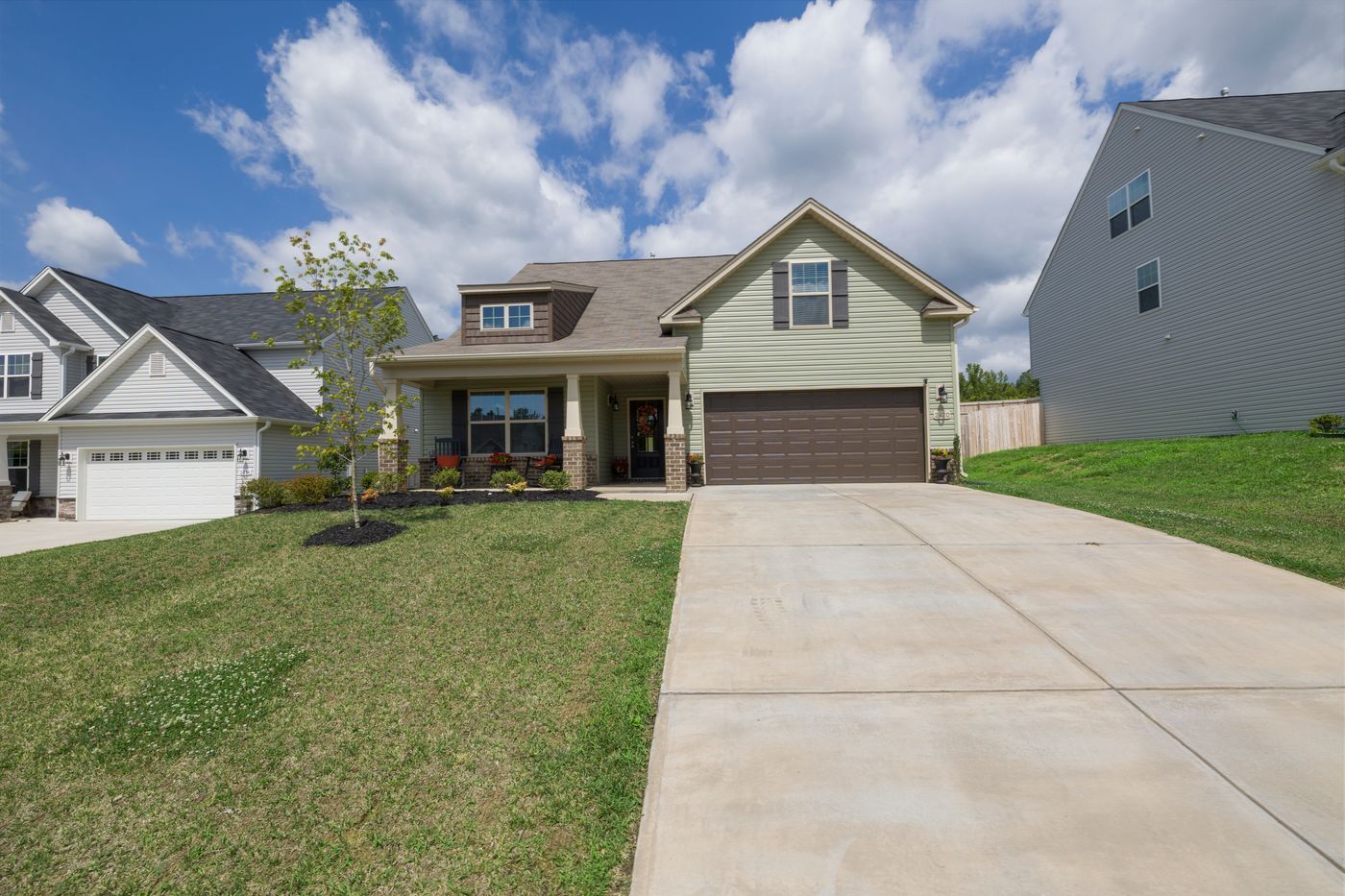
The coffee was still hot when I noticed the driveway.
It was 6:40 on a Tuesday morning in March. I stood at my kitchen window in Columbus with a mug in my hand and stared at an empty rectangle of concrete, and my brain offered me every explanation except the true one. My wife moved it. The city towed it. I parked on the street and forgot. It took a full minute — a genuinely stupid, coffee-cooling minute — to accept that my 2016 Honda CR-V, the most boring car in Ohio, was gone.
And before we go one step further: if that's how your week started too, or if it just happened two doors down and you can't stop thinking about it — none of what follows is your fault. Nobody teaches this. There is no class on what actually happens after a car is stolen. I'm going to give you the whole bill, because I've now paid it, and because the last section of this article is the thing I wish someone had shown me in February.
The report that goes into a drawer.
The officer who came out was kind, professional, and — I'll give him this — honest. He took photos of the oil stain, wrote everything down, gave me a case number on a card, and told me the truth: if a plate reader doesn't catch it in the first day or two, most of these cars either don't come back or come back in a condition you don't want.
That case number is the single most useless object I have ever owned. You need it for the insurance claim. You need it for the DMV. And that is the entire career of a stolen-car case number. Mine sits in a kitchen drawer next to the spare key to a car I no longer have — a key that, I'd learn later, was part of the problem.
What the check actually covers. (Sit down.)
Here's the part I genuinely did not know, and I've carried full coverage for twenty years.
When a stolen car isn't recovered, your insurer typically doesn't pay what it costs to replace your car. They pay actual cash value — what the market says your used car was worth at the moment it disappeared. Those are very different numbers, and the gap comes out of you.
My adjuster was perfectly pleasant about it. The valuation on my CR-V came in thousands of dollars under the cheapest comparable CR-V listed within a hundred miles — same year, more miles, worse condition. Then the deductible came off the top of that. And none of it happened quickly: theft claims typically sit in a waiting period — often weeks — while the insurer waits to see if the car turns up. Mine took the better part of six weeks. My rental coverage capped out long before the check arrived. I drove my mother-in-law's Buick to work through most of April.

Stolen car ≠ replaced car. It's: (what your used car was worth) − (your deductible) − (weeks of waiting) − (rental days past your cap) — and then you go shopping in a used-car market with a check that's short of every listing you can find. That gap is real money, and it's yours.
The stuff inside the car. All of it. Gone, and not covered.
This is the line item that made my wife cry, and it wasn't the car.
In the back seat: both kids' car seats. In the console: my dashcam — a beautiful irony, filming the inside of a car I'll never see again — my prescription sunglasses, the gym bag, and about forty dollars of accumulated parking-meter quarters. Clipped to the visor: the garage remote.
Here's what I learned in one bad afternoon: personal items inside a stolen car usually are not covered by your auto policy. That's a homeowner's or renter's claim — with its own deductible, which in my case swallowed most of what was taken. Car seats, dashcam, everything — gone, and functionally uninsured.
And the garage remote is worse than a loss. The registration in the glove box has your home address on it. So whoever had my car also had a button that opens my house, and a document telling them where the house is. I paid a locksmith that same week to re-code the garage and re-key the front door, and for about a month my wife checked the door chain like it was a job.
Then the renewal letter arrived.
Ten weeks after the theft, my insurance renewal came in higher. Not dramatically — insultingly. A theft claim can raise your premium, and mine did: I got to pay more, going forward, for the privilege of having been stolen from. When people say "the insurance will take care of it," this is the part they've never lived through.
Here's the twist: car theft is going down. That's exactly why mine went.
When I finally started reading — and after a loss like this, you read — I expected to find an epidemic. I found the opposite. National crime-bureau data shows US vehicle thefts fell to 659,880 in 2025, down 23%.
So why was my driveway empty? Because the drop isn't thieves giving up. It's thieves getting pickier. Modern car theft runs on a time budget: a thief evaluates a car in seconds, and anything that looks slow gets skipped for something faster. The hard targets survive. The easy targets carry the whole statistic. Theft didn't shrink so much as it concentrated — onto cars like mine.
The evidence is all over the data. Kia and Hyundai models from 2011–2022 built without engine immobilizers — the ones from the TikTok-method videos — still accounted for about 14% of all US thefts in 2025. One in seven stolen cars, from a handful of easy models. And the automakers' official remedy for those millions of owners? They handed out steering wheel locks. Not an app. Not a subscription. A visible, physical lock on the wheel — because that's what actually changes a thief's seconds-long decision.
Newer cars aren't exempt; they're just easy differently. Security researchers who tested keyless models found roughly 85% remain vulnerable to relay attacks — the two-briefcase trick that reads your fob through your front door and drives off without breaking glass. In the UK, keyless thefts rose 57% in three years, and the technique is spreading here too. Remember my spare key in the kitchen drawer, thirty feet from the driveway? Right.
Burglars skip houses with alarm signs — not because a sign stops anyone, but because the house next door doesn't have one. Car thieves run the same arithmetic at the curb, in seconds. You don't have to make your car impossible to steal. You have to make it visibly slower than the one parked next to it.
So I went shopping for "slower." Almost everything failed.
The replacement CR-V (older, higher miles — see check-gap math, above) was not going to sit in that driveway unprotected. I spent two weeks researching like it was my job. Here's the graveyard:
- An aftermarket alarm. Be honest: when did you last hear a car alarm and do anything but feel annoyed? Neither has a thief. An alarm is noise during a theft, deterrence-after-the-fact. And it's invisible from the curb — it changes nothing about the seconds-long decision.
- A GPS tracker. Useful — for finding out where your car went. A tracker doesn't prevent anything; it narrates the loss.
- A professionally installed immobilizer — quoted at $1,500. Genuinely effective, and thirty times the price of what I ended up with, plus an install appointment, plus it's invisible from the sidewalk — so the thief still breaks your window to find out. The broken window alone is a deductible.
- The old bent Club from my dad's garage. I know what you're thinking, because I thought it too: steering wheel bars were defeated thirty years ago. The old ones, yes — pry the bar, or worse, it's so heavy and awkward that it lives on the floor mat after week two. A lock you stop using protects nothing. This objection turns out to have a very good answer, but the answer isn't the old bar.
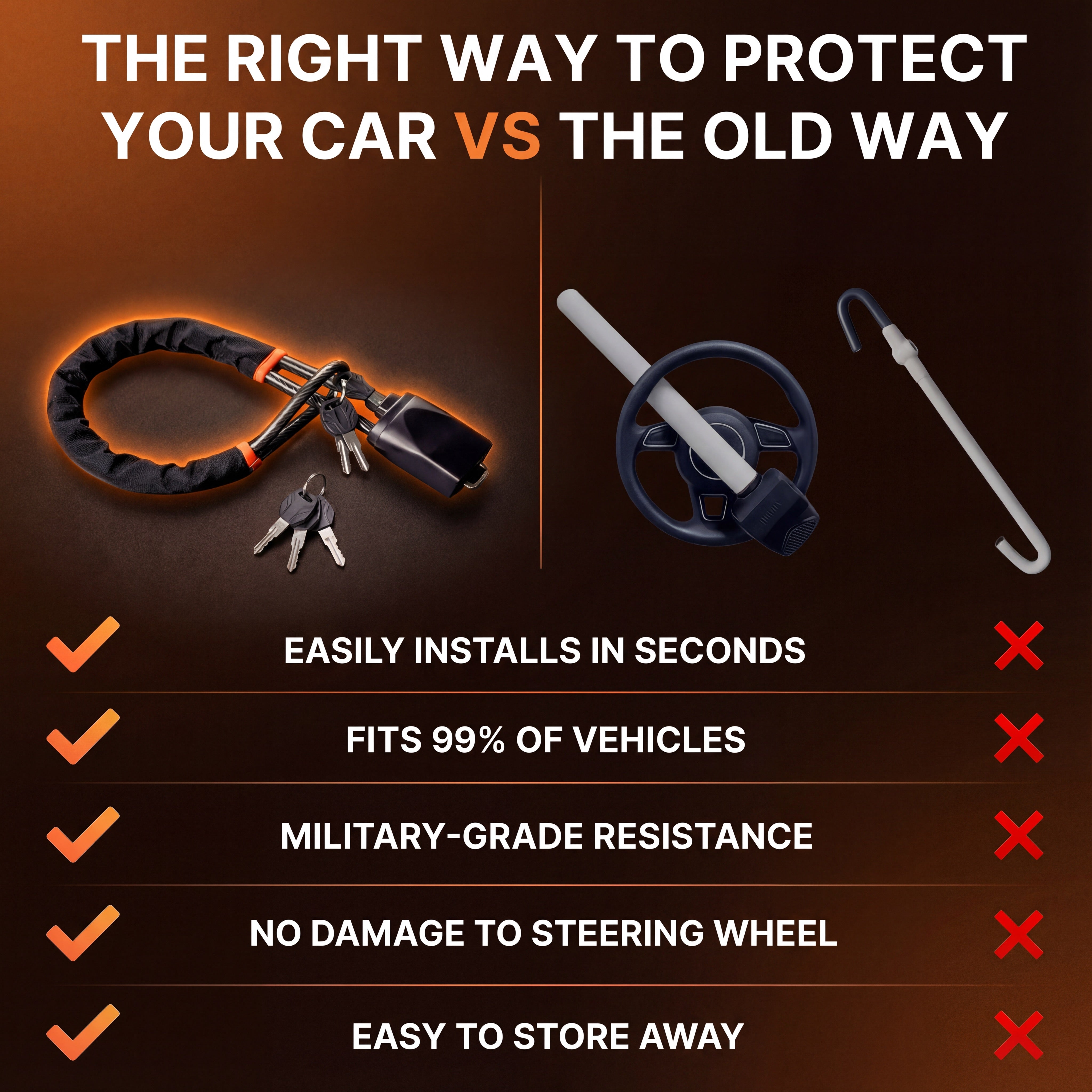
Lay those failures side by side and a spec sheet writes itself. The right answer had to be visible from the sidewalk (so the thief's decision happens before the window breaks), anchored to something a pry bar can't pop (so it isn't the old Club), and so fast to use that I'd actually use it every single night (because the lock that stays in the trunk is decoration).
I found it in the comments under a theft-victim thread, of all places: "guess I'm buying a steering wheel lock" — and a reply pointing to the one that had been making the rounds on Instagram. It's called the BEAM Lock, from BEAM Lab, and the clever part isn't the lock. It's what the lock holds onto.
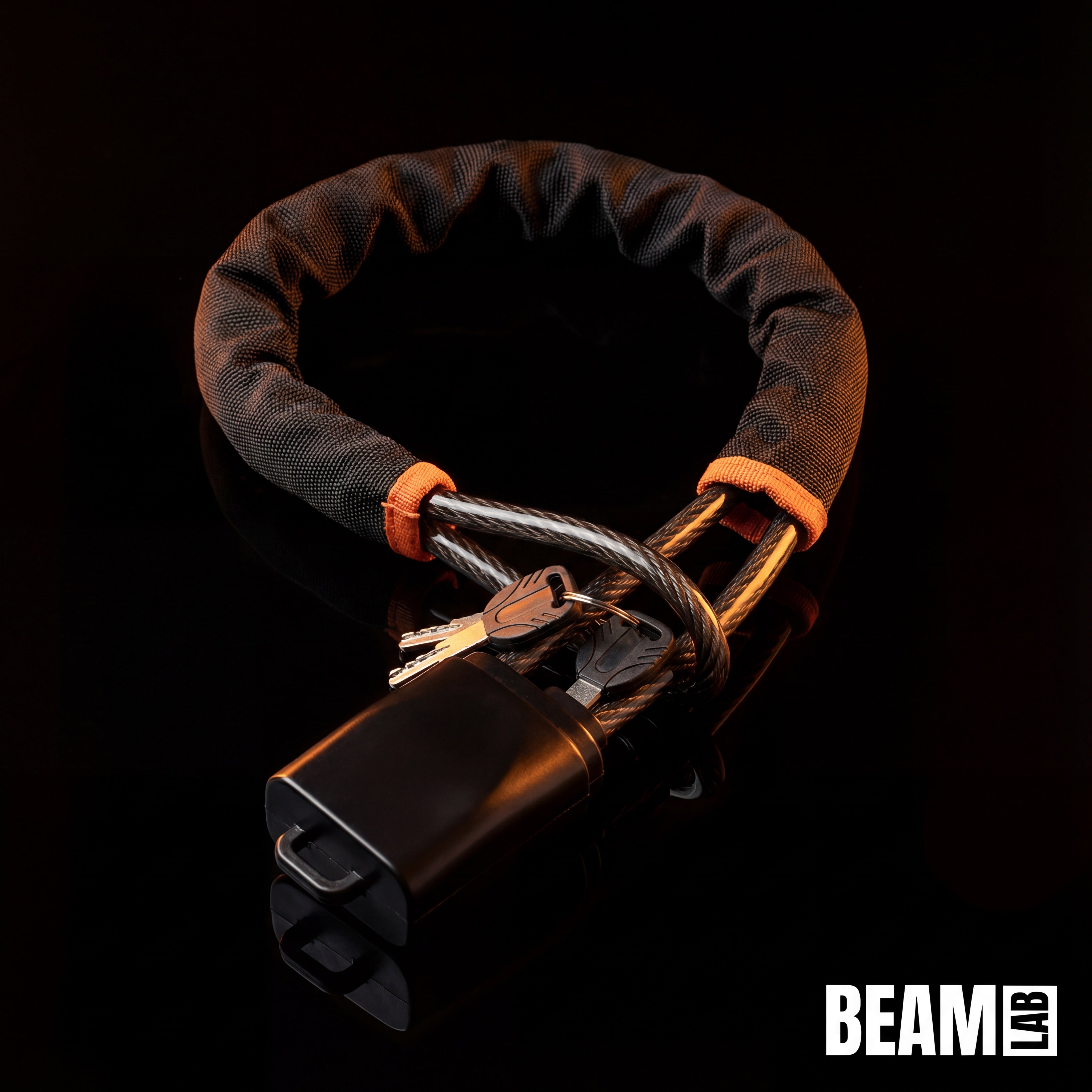
The seatbelt-buckle trick: why this isn't your dad's Club.
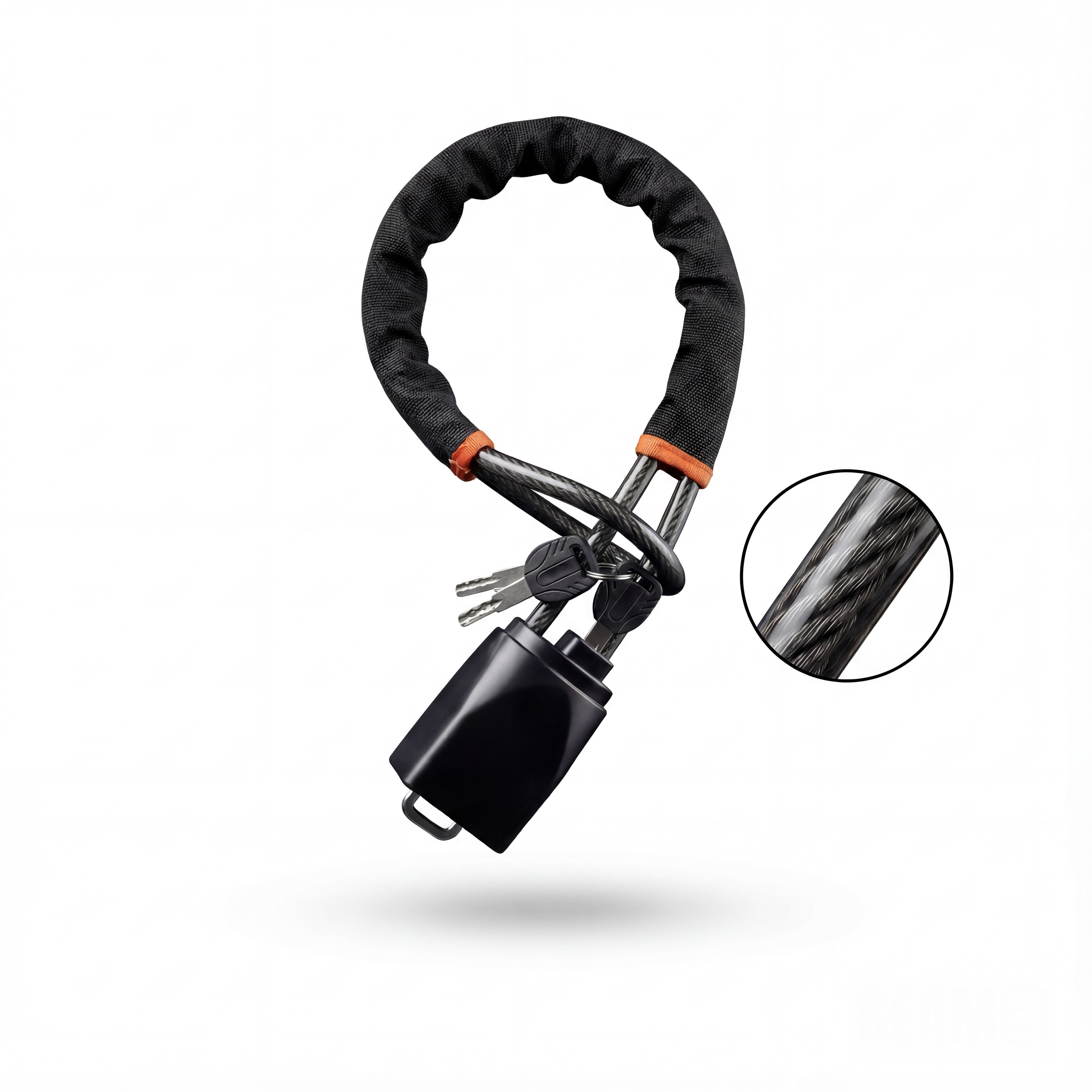
Here's the whole mechanism, and it's almost annoyingly simple. A 5mm steel cable loops around the rim of your steering wheel — and then clicks straight into your car's own seatbelt buckle.
Stop and think about what a seatbelt buckle actually is. It's the one component in your cabin engineered to hold a human body in a crash — crash-rated to hold thousands of pounds — bolted into the structure of the car, and physically incapable of releasing without its key... which is now this lock's key. The old Club clamped onto the wheel and dared you to pry it. The BEAM Lock borrows the strongest anchor your car already has.
With the cable in the buckle, the wheel physically cannot turn. And that's the detail that covers the modern thefts too: even if someone bypasses the ignition entirely — the TikTok method, a relay attack on a push-button car, a cloned fob — the car starts but cannot be steered. A car that can't steer can't leave the driveway. It's roughly the least valuable object a thief has ever sat in.
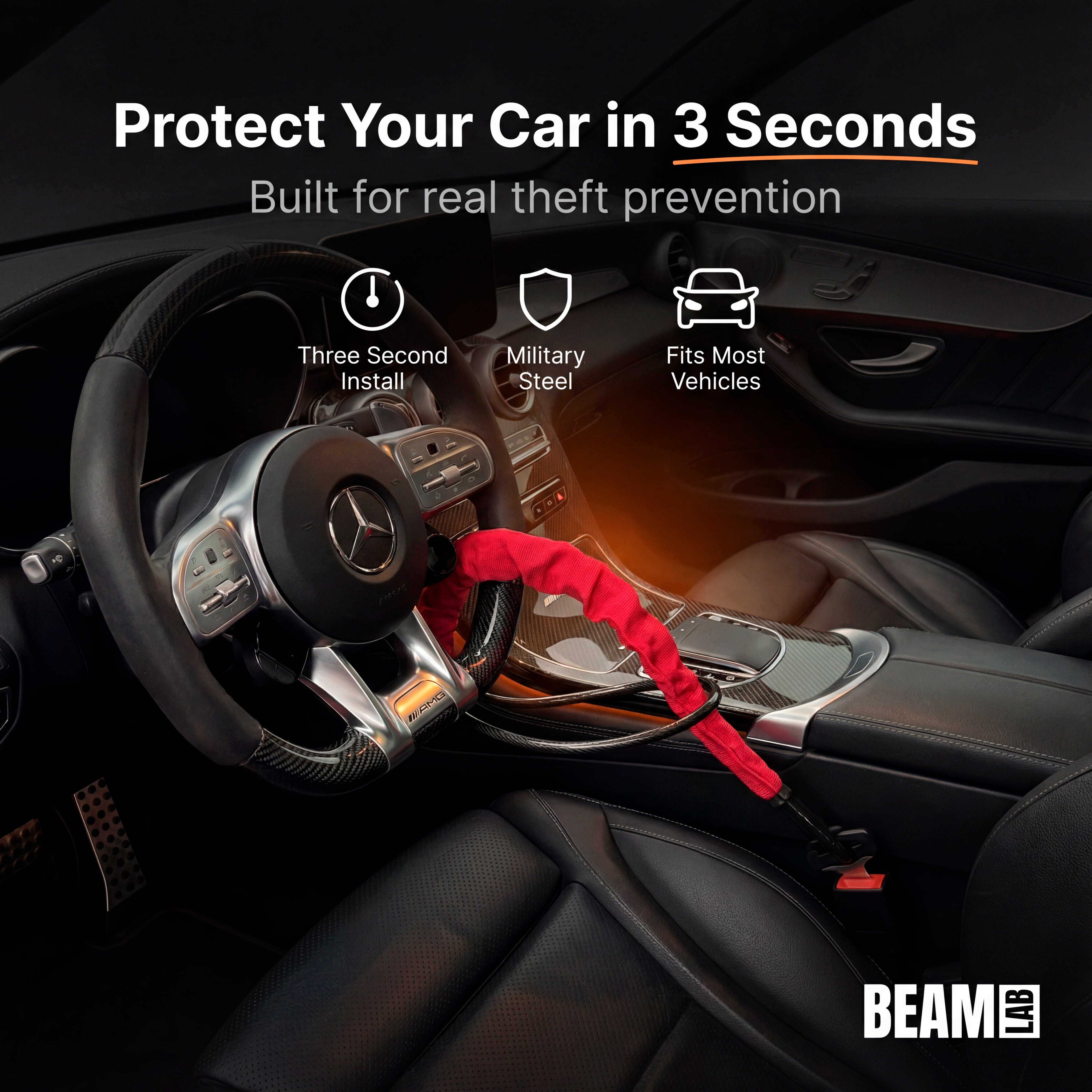
Installing it takes three seconds: loop, click, turn the key. That number matters more than any steel spec on this page. The Club died because it was a chore, and chores get skipped, and the one night you skip it is the night that counts. Three seconds is faster than plugging in your phone. It stops being a security measure and becomes a reflex — Theresa, whom you'll meet in a minute, calls it the last click of the night.
The rest of the spec sheet, per BEAM Lab's own testing: the 5mm military-grade steel cable resists over 2 tons of pulling force and has been tested against bolt cutters, saws, and grinders; the lock cylinder is rated for 50,000+ open-close cycles; the cable wears a protective coating so it won't chew up a leather, wood, or plastic wheel; and it fits 99% of cars, trucks, and SUVs from the last 30 years, any wheel diameter — because every one of them has the same anchor point: a seatbelt buckle.
A steering wheel lock is a deterrent, not a fortress. Given unlimited time, privacy, and power tools, a determined professional can defeat any consumer security device ever made — anyone who tells you otherwise is selling you a fairy tale.
But that's not the test. The thief in your driveway at 3 a.m. is not a movie villain with a workshop; he's a person on a strict time budget making a seconds-long decision between your car and the identical one down the street. A bright cable locked across the wheel, visible through the glass, answers his only question — "how long will this take?" — with "too long." As one owner put it on a forum: "they just move to the next car." The goal was never to be unstealable. The goal is to never be the easy one. That's the whole game, and $49.95 buys you out of it.
12,000 driveways ahead of me.
I was late to this. The BEAM Lock blew up the way things blow up now — a demo clip of the loop-click-turn racked up over 7 million views on Instagram, and BEAM Lab has since moved over 12,000 units. The number that actually sold me, though, is quieter: across all of those, only 0.3% have ever been replaced. For a steel thing that lives in a car and gets handled every single night, that's a failure rate I'd take in anything I own.
The reviews read like group therapy for people like me — fresh victims and the near-missed. The one BEAM Lab verified and published says it better than I can:
"I finally sleep through the night without obsessively checking my car. Takes literally 3 seconds and I actually use it every single day."
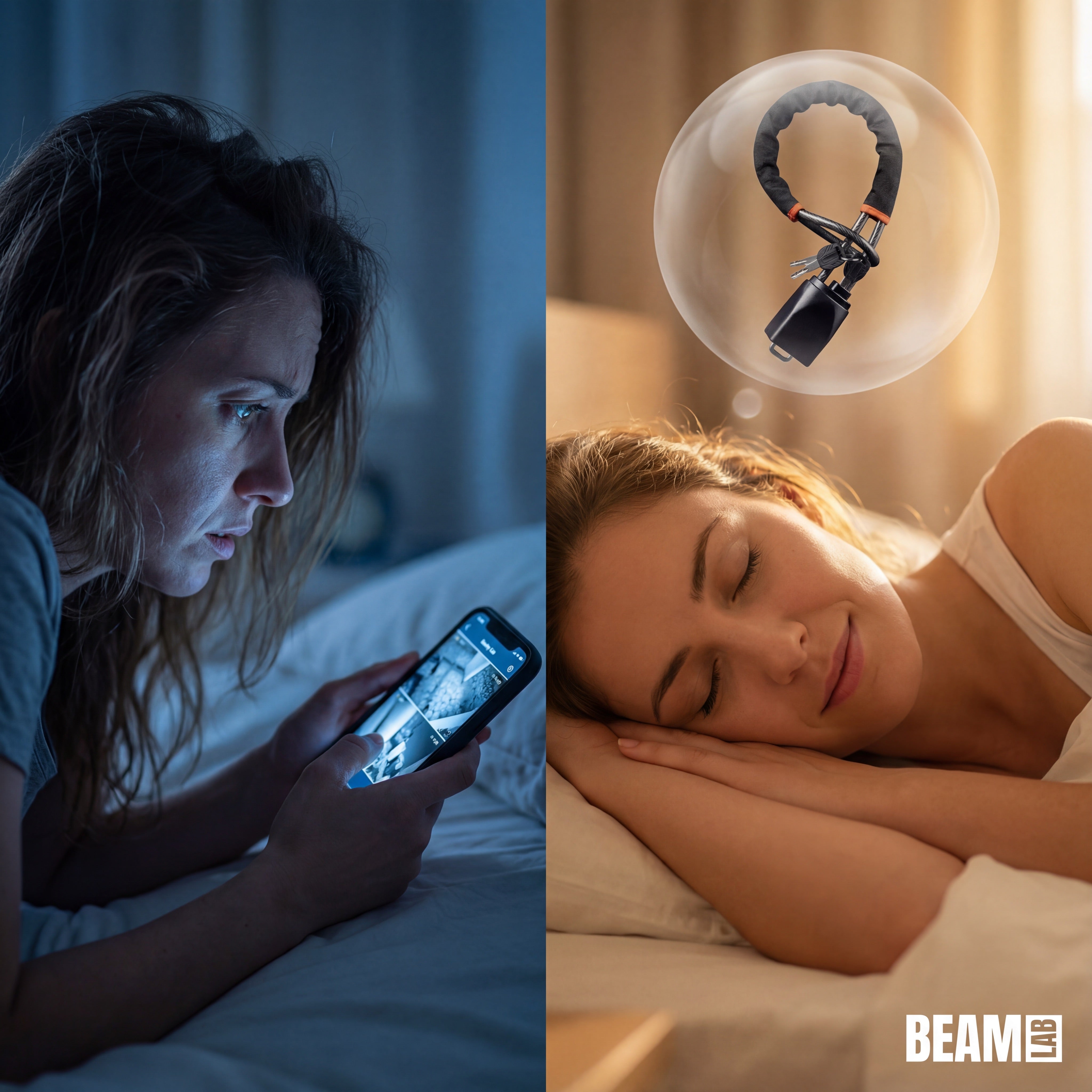
If you've been through it, you know exactly what she means by obsessively checking. For two months after the theft, I woke at every headlight sweep across the ceiling. My wife kept her phone on the window sill. That's the actual product here. The steel is just the delivery mechanism.
The forum threads run the same way. One owner: "visible enough that they know they'll need more time" — which is the entire deterrence argument in nine words. Another, after their neighbor's car went instead: "I'm layering everything now." That one's me. The BEAM Lock is my visible layer, the one doing the deterring from the curb.
What it costs — against what I've already paid.
The BEAM Lock is $49.95, marked down from $99.95 — BEAM Lab is holding launch pricing since the Instagram wave, and they're upfront that it won't hold forever. If you've got more than one car in the driveway — and remember, the thief is comparing them — multi-car bundles save up to 50%.
Now put $49.95 next to my Tuesday: the gap between actual cash value and a real replacement car. The deductible. The car seats and the dashcam nobody covered. The locksmith. The rental days past the cap. The renewal letter. The month my wife slept badly. I will not pretend to be a neutral reviewer here: $49.95 against that list is the easiest math I've done all year.
Make Yours The Car They Skip.
- Loops the wheel, clicks into your car's own crash-rated seatbelt buckle — wheel physically can't turn, even if the ignition is bypassed
- 3-second install: loop, click, turn the key — fast enough to use every single night
- 5mm steel cable resists 2+ tons; tested against bolt cutters, saws, and grinders (maker's testing)
- Protective coating — safe on leather, wood, and plastic wheels · fits 99% of cars, trucks & SUVs from the last 30 years
- Multi-car bundles save up to 50% — one for each car in the driveway
- 30-day money-back guarantee · ships in 5–10 business days
GUARANTEE
Run the nightly click for 30 days.
Loop it, click it, live with it. If it doesn't buy you peace of mind — if you don't catch yourself sleeping through headlight sweeps again — send it back within 30 days for a full refund. No forms, no fight.
The questions I'd have asked. (Including the rude ones.)
Fair — and half right. The old bars failed two ways: they clamped only the wheel, so prying the wheel or the bar defeated them; and they were such a chore that owners quit using them. The BEAM Lock answers both: it anchors to the seatbelt buckle — a crash-rated fixture that has no pry point and can't release without the key — and it takes three seconds, so it actually gets used. And per the honesty box above: it doesn't need to be unbeatable. It needs to make a thief on a time budget pick a different car. That part worked 30 years ago too.
BEAM Lab's own testing put the 5mm steel cable against bolt cutters, saws, and grinders, and rates it against more than 2 tons of pulling force. But here's the honest answer: with enough time and a power tool, steel is steel. The point is that "enough time" is exactly what a thief in a driveway doesn't have — a grinder is loud, slow, throws sparks, and announces itself to the whole street. He's not fighting your cable. He's leaving.
The internet's favorite objection, so let's take it seriously. The cable sits flush around the rim and is anchored down into the buckle, so there's no slack to slip. Sawing through a steering wheel rim — steel core under the padding — is loud, awkward, slow work performed bent over a dashboard in someone's driveway. Could a determined person do it eventually? Yes. That's the fortress question again. The driveway question is "is this the easiest car on the block?" — and mid-rim-surgery is nobody's idea of easy.
This is actually where the buckle anchor shines. A relay attack convinces your car the fob is present — the engine starts without a single broken window. But a started car still has to steer out of the driveway, and with the cable in the buckle the wheel is fixed. Bypassing the ignition accomplishes nothing. (Researchers found roughly 85% of keyless models tested remain relay-vulnerable, so no, your newer car doesn't opt you out of this.)
It fits 99% of cars, trucks, and SUVs from the last 30 years, any wheel diameter — the anchor is the seatbelt buckle, and every car has one. The cable wears a protective coating specifically so it won't mark leather, wood, or plastic rims. Mine has clicked in and out every night since April; the wheel looks like it did the day I bought the car.
The lock cylinder is rated for 50,000+ cycles — at twice a day, that's decades of nightly clicks — and BEAM Lab backs it with lifetime replacement if it ever breaks. If it turns out not to be for you at all, every order carries the 30-day money-back guarantee: use it for a month, and if it doesn't buy you peace of mind, send it back for a refund.
P.S. — The replacement CR-V sleeps in the same driveway, in the same spot, under the same street light. The difference is a bright cable locked across the wheel that you can see from the sidewalk — which is precisely the point of it. Last month a neighbor two streets over had his sedan taken from in front of his house, and I heard myself giving him this entire article over a fence, ending with the same sentence I'll end with here. You're one of two people right now: your driveway is full this morning, or it isn't. If it's full, three seconds a night and $49.95 is what keeping it that way costs. I've priced the other option for you, line by line, above. Don't buy that one.
ADVERTISING DISCLOSURE: This is a sponsored editorial. The Commuter's Review earns a commission when readers purchase through the links in this article. Our reviews are independent; our revenue is not.
RESULTS DISCLAIMER: The BEAM Lock is a theft deterrent, not a guarantee against theft. No anti-theft device can prevent all vehicle theft in all circumstances. Strength and durability figures reflect the manufacturer's own testing, not independent certification. Insurance outcomes described reflect the author's experience and typical policy structures; coverage, valuations, waiting periods, and premium changes vary by insurer, policy, and state.
SAFETY NOTICE: Always remove the lock completely before operating the vehicle. Never attempt to drive with the lock installed.