
5 Things Car Thieves Check Before Picking A Car (The Whole Decision Takes Seconds)
Car thieves don't pick cars the way you'd guess. They don't case a car for an hour. They walk the block once, run a checklist that takes a few seconds, and take the easiest yes. Here is the checklist — and how to fail it on purpose.
5 Things Car Thieves Check Before Picking A Car (The Whole Decision Takes Seconds)
Your car isn't chosen. It's shortlisted. Five quick checks decide whether a thief works on your car tonight or walks past it to your neighbor's. Here they are, in the order a thief runs them.
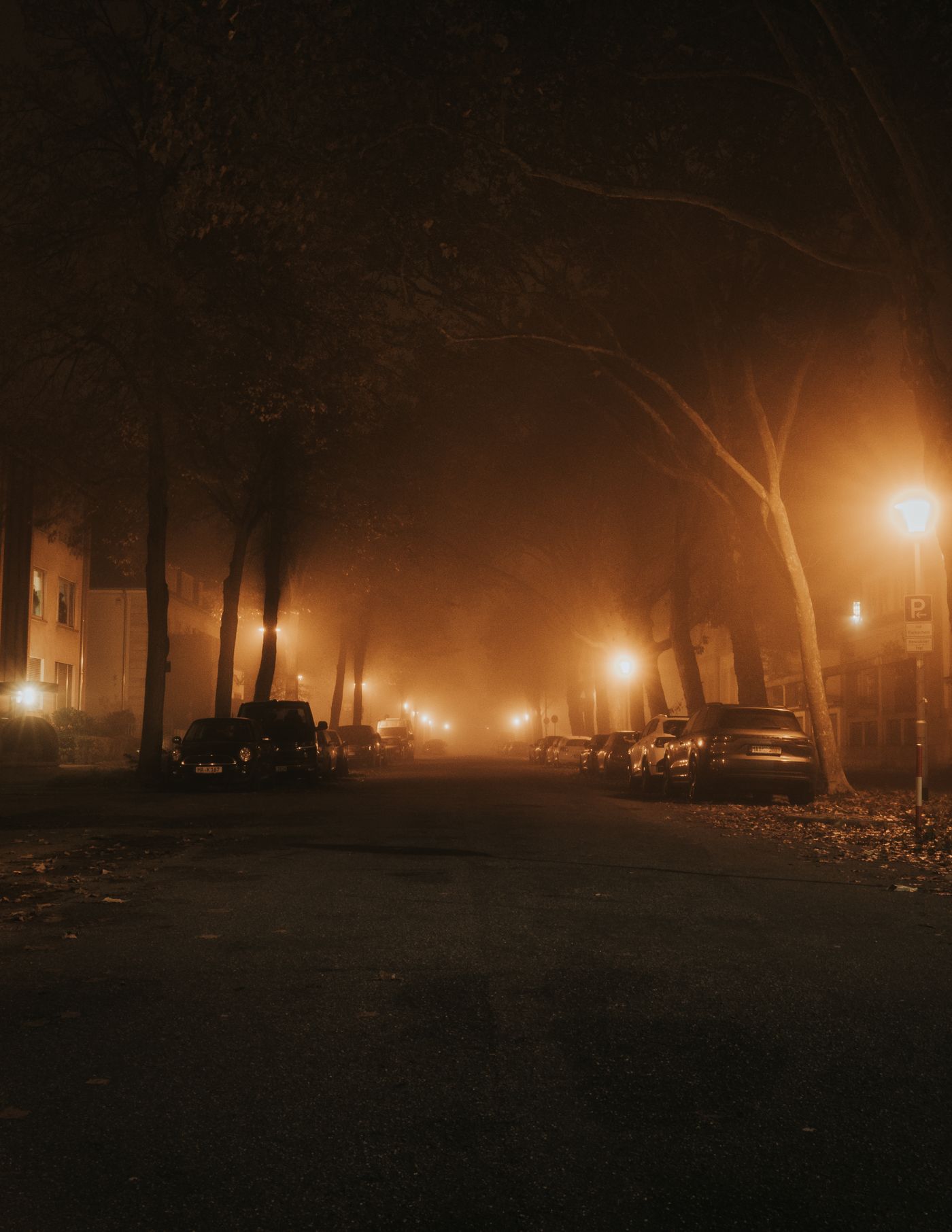
Nobody "targets" your car. Somebody walks this street, runs five checks, and takes the easiest one on it.
Here's a number that sounds like good news: vehicle thefts in the US fell to 659,880 in 2025 — down 23%, according to national crime-bureau data. Cities celebrated. Headlines said the wave was over.
Ask the people who study how thieves actually work and you get a colder read: thefts didn't fall because thieves quit. They fell because thieves got pickier. Immobilizers, cameras, and doorbell footage made the average car harder to take — so the people still stealing cars stopped taking average cars. They walk the block, skip the hard targets, and take the easy ones. Every one of those 659,880 cars was, in a judgment that took somebody a few seconds, the easiest car on its street.
Nobody teaches you this. That's not your fault — driver's ed covers parallel parking, not target selection. One owner put it this way on a forum after his car vanished from in front of his house: "I figured no one would bother stealing my car." Wrong frame. Thieves don't want your car. They want the easy car. Tonight, on your street, one car is it.
US vehicle thefts fell to 659,880 in 2025 — down 23% — as thieves abandoned hard targets for easy ones (national crime-bureau data).
Kia and Hyundai models from 2011–2022 — many built without engine immobilizers — still accounted for 14% of all US thefts in 2025. The automakers' own remedy? Handing owners steering wheel locks.
Security researchers found roughly 85% of keyless models tested remain vulnerable to relay attacks — the "steal it without your keys" method that's spreading here too.
So the question isn't "will a thief come to my street?" Someone eventually walks every street. The question is: when they run the checklist on your car, what does it say? Here are the five checks — and the counter-move for each one.
The sidewalk checklist
Where it's parked — dark street beats lit driveway, every time.
Check one takes half a second and happens from thirty feet away. A car on a dark street, between streetlights, away from doors and windows, is a workspace. A car in a lit driveway, under a camera, near a front door, is a risk. Thieves are not brave. They are efficient. Street-parked cars get picked first for the same reason ground-floor apartments get burgled first: nobody has to commit to anything to get close.
The counter-move: you usually can't change where you park — city parking is street parking. So accept that check one goes against you, and make sure the checks the thief runs up close go your way. That's what the rest of this list is for.
Whether your model is on the hot list.
Some cars are stolen because of what they are. Kia and Hyundai models from 2011–2022 shipped without engine immobilizers, a social-video method for starting them went viral, and in 2025 those models still made up 14% of every car stolen in America. Trucks and SUVs with high resale parts sit on the list too. If your model is hot, a thief doesn't need a reason. Your VIN is the reason.
Here's the detail worth remembering: when the Kia/Hyundai wave hit, the automakers' official fix — the thing they handed out to affected owners — was a steering wheel lock. Not an app. Not an alarm. The oldest category of car security there is, because it attacks the one thing every theft method still needs: a wheel that turns.
The counter-move: if your model is on the list, assume you fail check two permanently — and stack the visible-deterrent check (number 5) so hard the thief never gets to check three.
What's visible through the glass.
A dashcam on the windshield. A bag on the seat. A charging cable snaking into the console — which promises a phone or a laptop somewhere in the car. Visible contents turn a maybe into a yes, because even if the car itself doesn't move, the window pays for the brick. One owner summed up the aftermath in eight words: "Car seats, dashcam, everything — gone."
And here's the part that stings twice: your auto policy typically covers the car, not what was inside it. Personal items usually fall to your home or renter's policy — if you have one, and if the deductible doesn't swallow the claim. As another owner put it: "insurance won't pay for what was inside."
The counter-move: empty glass. Cables in the console, dashcam unclipped, seats bare. Make the interior say there is nothing here worth a window.
Whether your car sits on a schedule.
The first pass down your block isn't always the theft. Sometimes it's inventory. A car that sits in the same spot from 7pm to 7am, every night, tells anyone paying attention exactly when they'll have twelve undisturbed hours. Predictability is a gift to a thief: it converts a risky snatch into a planned pickup.
The counter-move: you can't randomize your life — you sleep when you sleep. What you can do is make the predictable hours defended hours. This is where the nightly ritual comes in: the owners who beat this check are the ones who lock the wheel every night the way they lock the front door. Three seconds, every night, same as brushing your teeth. Which brings us to the check that decides everything.
The deal-breaker: whether they can see a deterrent from the sidewalk.
This is the check that ends the audition. A thief leaning toward your window is doing time-budget math: how many seconds between me and this car driving away? Alarms don't change the math — everyone, including thieves, ignores alarms. GPS trackers don't change it — a tracker finds your stripped shell afterwards. A $1,500 immobilizer install changes it, invisibly, which means the thief still breaks your window to find out. But a lock they can see from the sidewalk changes the math before they touch the car.
This is where most people picture the old bent Club from 30 years ago — the heavy bar thieves learned to beat by hacksawing the wheel rim. Fair. That's exactly why the modern version anchors somewhere else entirely.
The BEAM Lock — BEAM Lab's Anti-Theft Steering Wheel Lock — loops a 5mm steel cable around the rim of your steering wheel and clicks straight into your car's own seatbelt buckle. That buckle is crash-rated to hold thousands of pounds, and it cannot release without the key. The wheel physically cannot turn. Even if a thief bypasses the ignition completely — the Kia method, a relay attack on a push-button car, a stolen key — the car cannot be steered. A car that can't steer can't leave the block.
Install time: 3 seconds. Loop, click, turn the key. That's the whole nightly ritual.
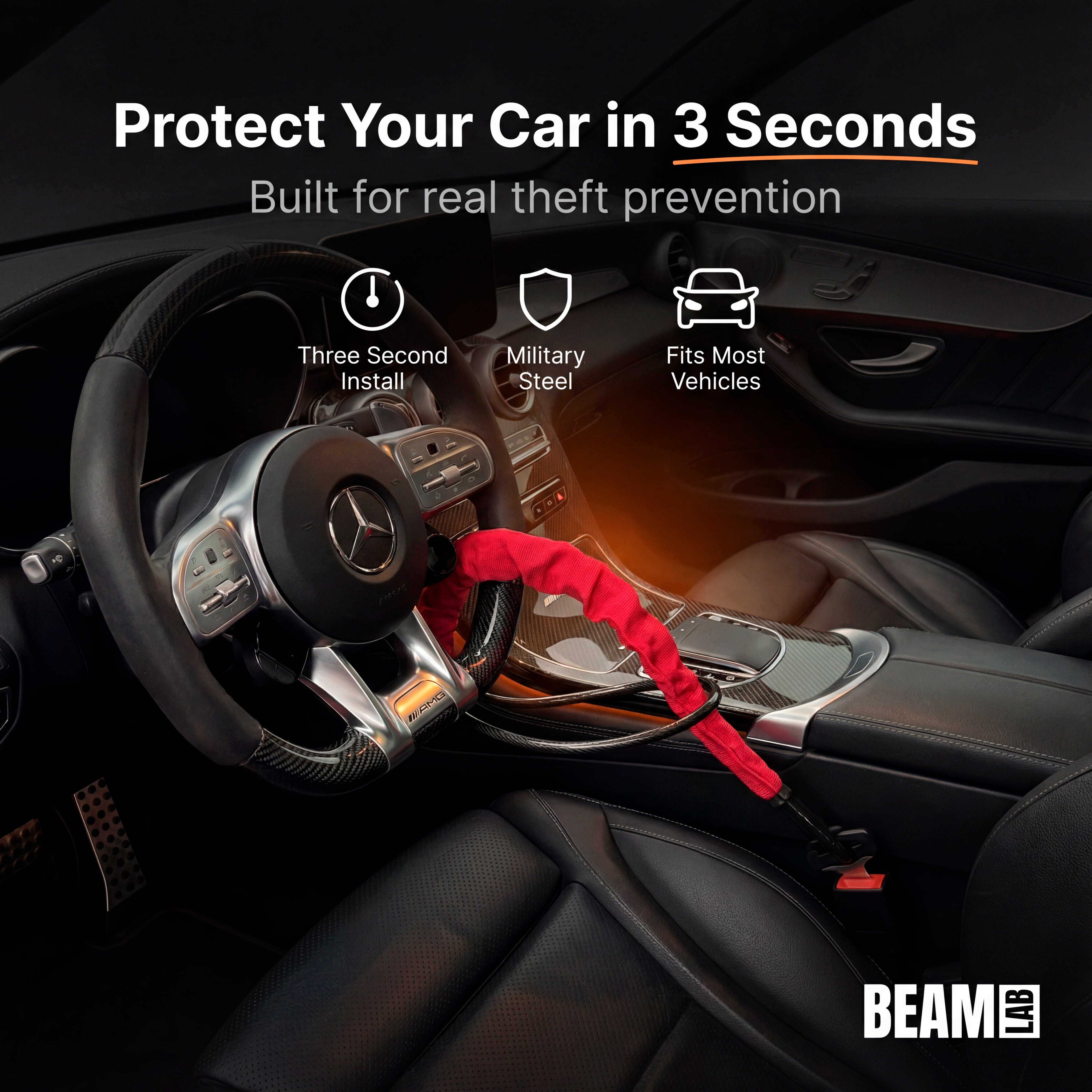
Loop the cable around the rim, click it into the seatbelt buckle, turn the key. Three seconds, and the wheel is dead weight.
Now the honest part, because it matters more than the specs: a steering lock is a deterrent, not a fortress. Given unlimited time and a workshop, any lock ever made can be beaten. But a thief on a sidewalk doesn't have unlimited time — time is the one thing they budget. A visible lock across the wheel tells them, from thirty feet, exactly what one owner said it should: "visible enough that they know they'll need more time." And what do thieves do when a car needs more time? The line that shows up in report after report: "they just move to the next car." That's the entire strategy. You don't have to make your car impossible to steal. You have to make it a worse deal than the one parked behind it.

The moment every check leads to: the pull on the handle. If it costs him more seconds than the car next door, you win.
Built for the sidewalk glance — and the bolt cutter, in case they stay
Deterrence does the real work, but BEAM Lab built the lock for the rare thief who doesn't take the hint. In the maker's own testing, the 5mm steel cable resists over 2 tons of pulling force and has been tested against bolt cutters, saws, and grinders. The locking mechanism is rated for 50,000+ open-close cycles — that's the nightly ritual, twice a night, for decades. A protective coating means it won't scratch leather, wood, or plastic wheels. And because it's a cable, not a rigid bar, it fits 99% of cars, trucks, and SUVs from the past 30 years, any wheel diameter — then folds small enough to live in your door pocket all day.
Compare that to the old way. The Club-style bar weighed as much as a dumbbell, rolled around the footwell, took a wrestling match to mount — so people stopped mounting it. A deterrent you leave in the trunk deters nobody. The BEAM Lock's entire design brief was the opposite: make the protected state so fast that you actually do it, every single night.
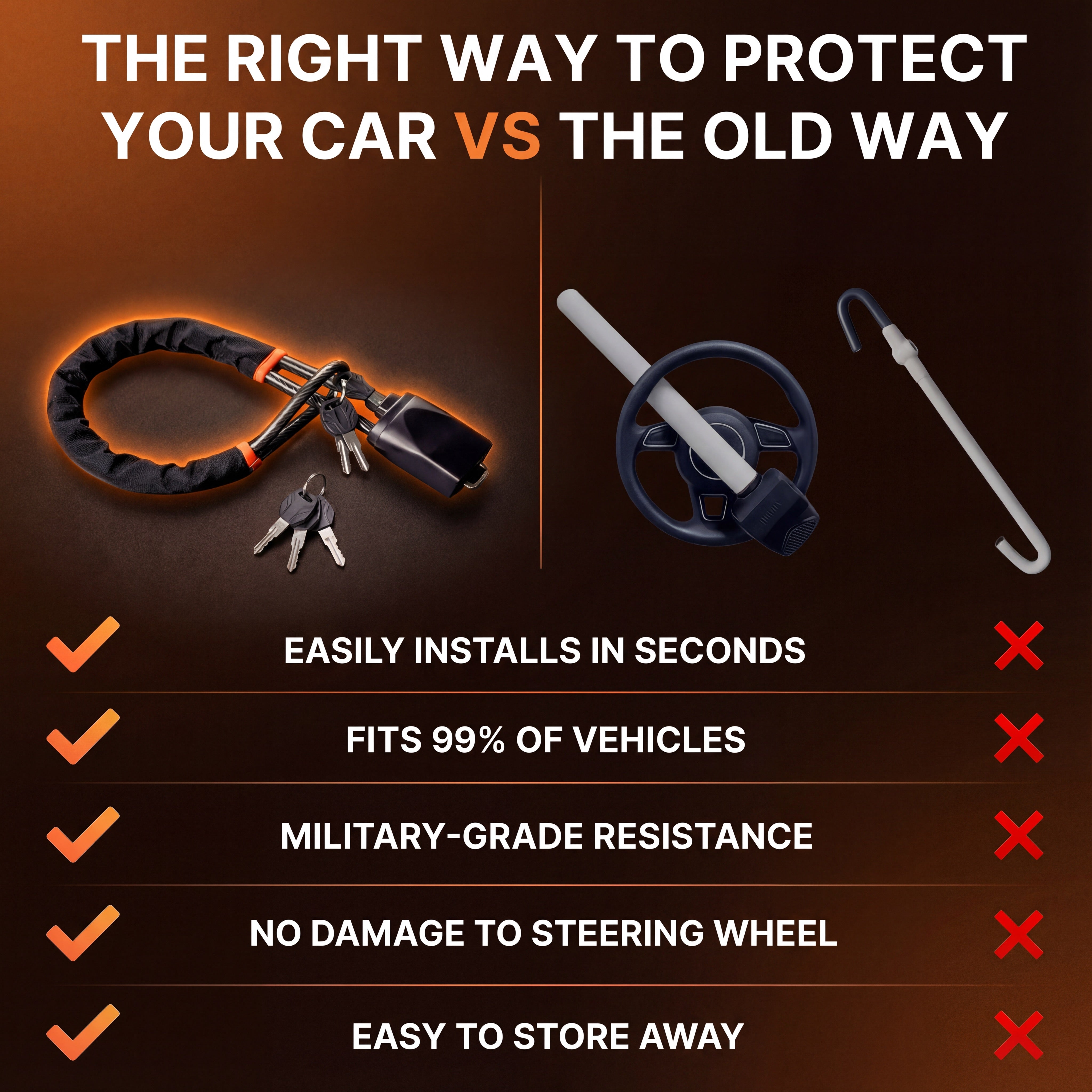
The old way anchored to the wheel it was protecting. The new way anchors to a crash-rated buckle built to hold thousands of pounds.
Why the buckle anchor beats the old bar
12,000 wheels locked — and the one review that says it best
The BEAM Lock blew up the way car products do now: a demonstration clip pulled over 7 million views on Instagram, and the orders followed — over 12,000 units sold to date. The number BEAM Lab watches more closely is quieter: just 0.3% of units ever replaced. For a device whose whole job is to get clicked open and shut every single night, that's the spec that matters.
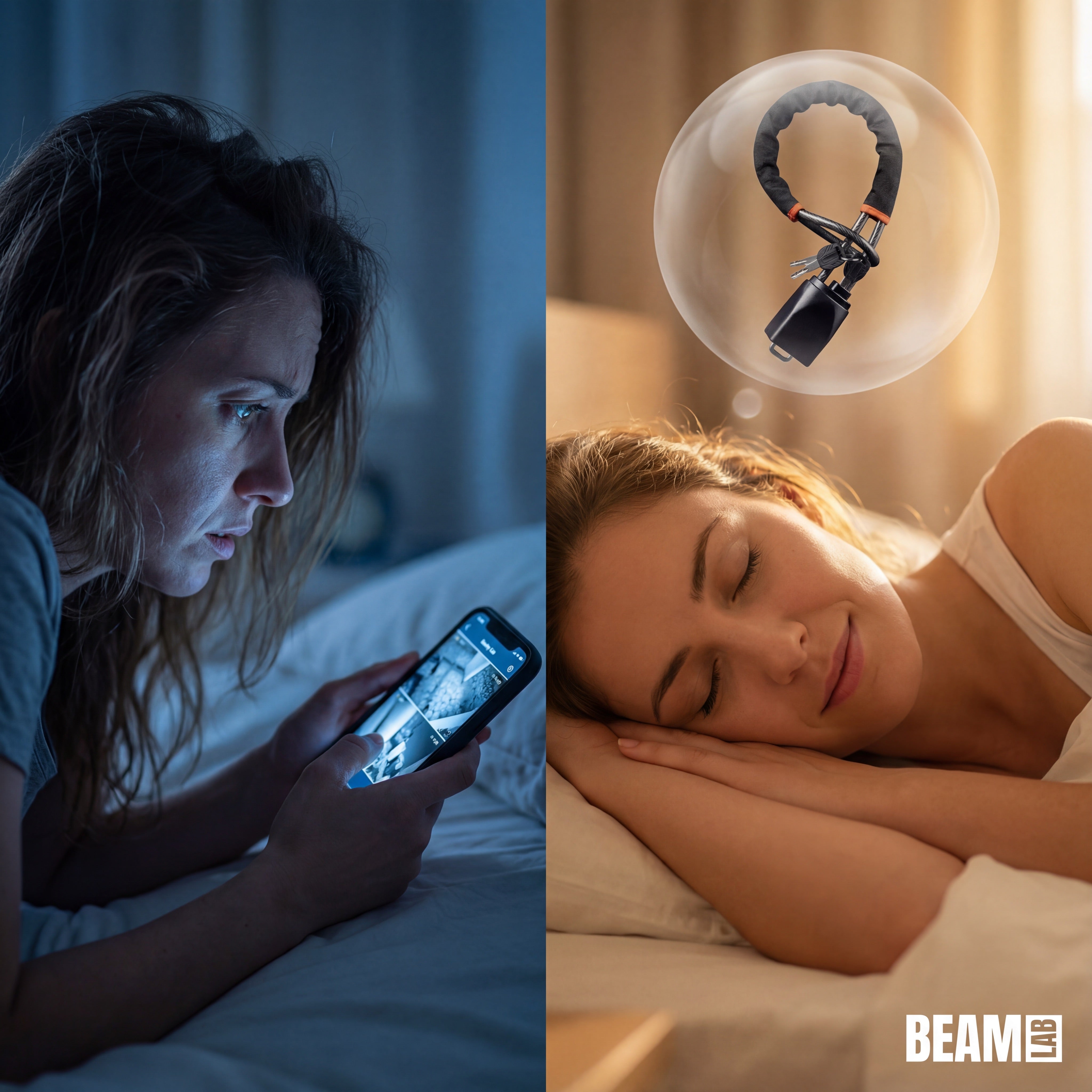
The before-and-after most owners describe isn't about the car. It's about the 2am check out the window — and not needing it anymore.
That's the thing nobody puts on a spec sheet. The fear isn't only losing the car — it's the broken window even when the car isn't taken, the glass on the seat, the weeks of claims. What a visible lock buys you is the version of tonight where none of that starts: the thief runs the checklist, your car fails it, and you find out nothing happened — because nothing happened.
What it costs to be the car they skip
$99.95$49.95
The BEAM Lock lists at $99.95. Right now it's $49.95 — launch pricing BEAM Lab is holding while the Instagram wave is still bringing in first-time buyers. If more than one car sleeps outside your place, multi-car bundles save up to 50% — one for each car in the driveway, because the thief walking your block will simply pick whichever one isn't wearing a lock.
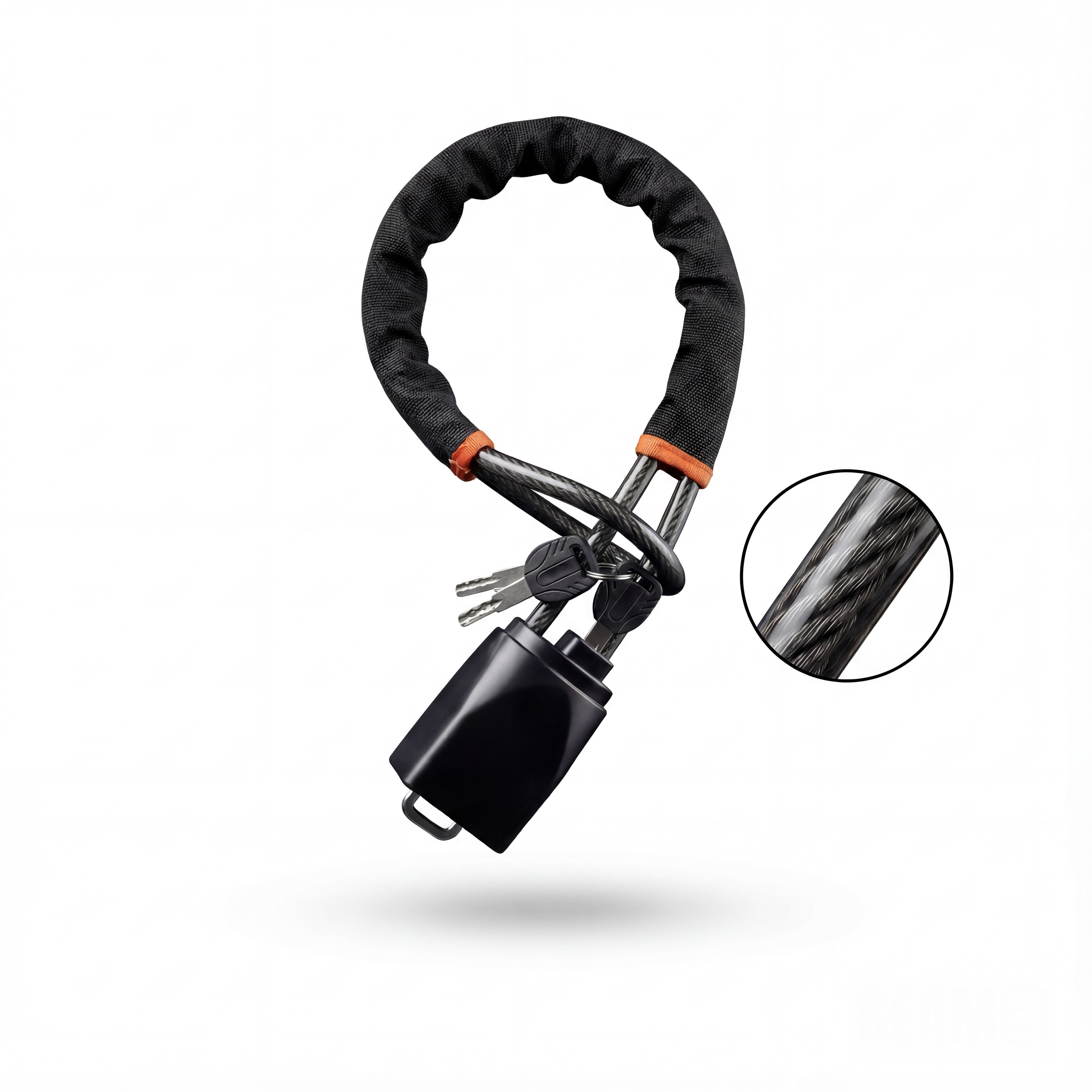
5mm steel cable, keyed lock, coated so it won't mark the wheel. Small enough for the door pocket by day.
Set it against the other side of the ledger. An unrecovered stolen car typically pays out at actual cash value — what the car was worth, not what replacing it costs. A theft claim can raise your premiums for years. Whatever was inside is usually not covered by your auto policy at all. And the payout, when it comes, can take weeks — weeks of rides, rentals, and paperwork. Fifty dollars is what the first hour of that costs.
Be the car they skip — starting tonight.
$49.95 (regularly $99.95, launch pricing) · Multi-car bundles save up to 50% — one for each car in the driveway · 3-second install: loop, click, turn the key.
Get The 3-Second Steering Lock → 30-day money-back guarantee. If it doesn't buy you peace of mind, send it back. · Over 12,000 units sold Launch pricing — holding while the Instagram wave lastsQuestions street parkers ask before they buy
The Club didn't stop thieves 30 years ago. Why would this?
Two reasons. First, the anchor moved: the old bar locked onto the same wheel rim thieves learned to cut, while the BEAM Lock clicks into your seatbelt buckle — a crash-rated latch built to hold thousands of pounds that won't release without the key. Second, the goal is honest: it's a deterrent. It doesn't have to survive a workshop attack; it has to make a thief on a time budget look at your wheel, see extra minutes and extra noise, and move to the next car. That's the part that was always true — the Club's problem was that people stopped using it because it was a chore. Three seconds isn't a chore.
Can't they just cut the cable?
Not quickly, and quickly is the whole game. In the maker's testing, the 5mm steel cable resists over 2 tons of force and has been tested against bolt cutters, saws, and grinders. Could a determined crew with power tools and privacy eventually defeat it? Given enough time, any lock ever made can be beaten — we won't pretend otherwise. But attacking hardened cable inside a car, on a street, is loud, slow, awkward work, and the easier car is parked forty feet away.
What about cutting the steering wheel rim and slipping the lock off?
That was the classic anti-Club move, and it's why the design changed. The cable sits flush around the rim and anchors into the buckle, so there's no rigid bar to lever and no single exposed hook point. Sawing all the way through a wheel rim from inside a car is loud, slow work — exactly the kind of time a target-picker won't spend when the next car needs none.
My car is push-button start / keyless. Does this actually help?
It's arguably most useful there. Relay attacks trick your car into thinking the key is present — researchers found about 85% of keyless models tested are still vulnerable, and the method is spreading here too. A relay attack beats your ignition, not your steering. Locked wheel, no drive-away.
Will it scratch my steering wheel?
No — the cable and lock body wear a protective coating specifically so it won't damage leather, wood, or plastic wheels, even clicked on and off every night.
Will it fit my car?
It fits 99% of cars, trucks, and SUVs from the past 30 years, any wheel diameter — the cable adjusts where rigid bars can't, and every car with a seatbelt has the anchor built in.
What if it breaks — or I change my mind?
The lock is rated for 50,000+ open-close cycles, and BEAM Lab backs it with a lifetime replacement if it ever breaks. If it's not for you, the 30-day money-back guarantee covers you: return it for a full refund. Orders ship in 5–10 business days.
P.S. — Somewhere tonight, someone will walk a street like yours and run the checklist: where it's parked, what it is, what's inside, when it sits, and whether anything on the wheel says this one takes more time. You can't control the first four checks. The fifth one takes three seconds — loop, click, turn the key — and it's the one that sends them to the next car. Get The 3-Second Steering Lock →